

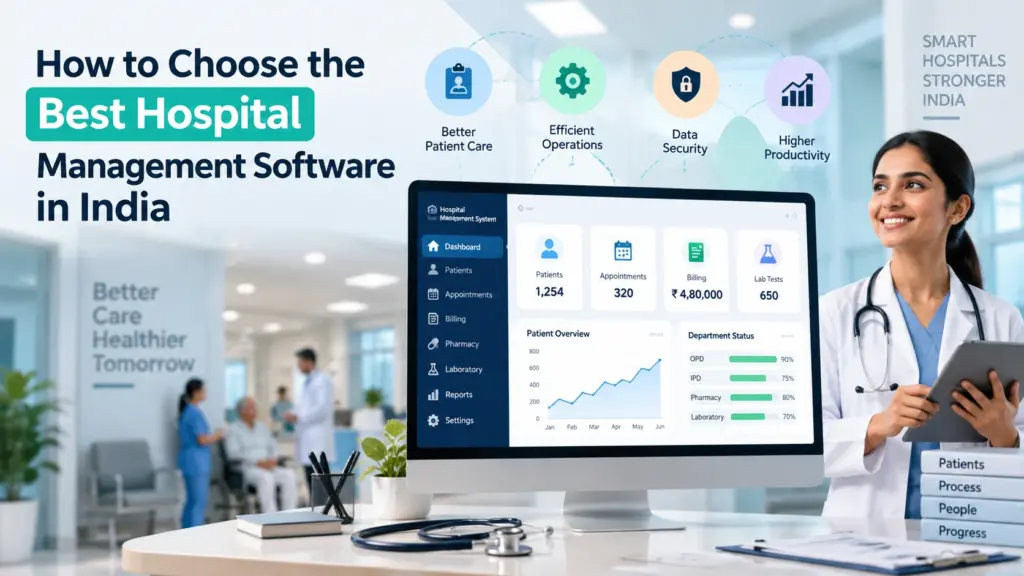
Choosing the right Hospital Management Software in India has become one of the most important decisions a healthcare facility can make. As hospitals digitise under national programmes like the Ayushman Bharat Digital Mission, paper registers and disconnected tools simply can’t keep up with the speed, compliance, and patient expectations of modern care. The right system connects every department, reduces errors, and frees your staff to focus on patients. This guide explains what to look for, what it costs, and how to shortlist the best option for your hospital, with practical pointers from the team at Neeti Healthcare.
What Is Hospital Management Software and How Does It Work?
Hospital Management Software is an integrated platform that runs a hospital’s clinical, administrative, and financial operations from one connected system. It links registration, appointments, electronic medical records, billing, pharmacy, laboratory, and reporting so that information entered once is available everywhere. Instead of separate registers for each department, staff work from a single, real-time source of truth. That cuts duplication, reduces mistakes, and speeds up everyday tasks.
Why Do Hospitals in India Need Hospital Management Software?
Hospitals in India need management software because rising patient volumes, compliance requirements, growing insurance and corporate tie-ups, and competition have made manual systems too slow and error-prone. Digital-first initiatives such as ABDM are also pushing facilities toward interoperable records. The upcoming full enforcement of the DPDP Act (Digital Personal Data Protection Act) in May 2027 will make digital consent tracking and stringent patient data privacy legally mandatory, so a compliant system helps hospitals stay efficient, accurate, and fully audit-ready ahead of the statutory deadline.
How Does It Improve Hospital Operations?
It connects departments so patient flow, orders, and billing move without manual handoffs. Queues shorten, reports are ready on time, and administrators get a live view of how the facility is performing.
How Does It Reduce Manual Work?
Routine tasks like registration, bill generation, record-keeping, and reminders are automated. This lightens the load on front-desk and back-office teams and reduces the transcription errors that come with paper.
How Does It Improve Patient Management?
Every patient has one complete digital record, accessible instantly during consultations. Doctors make better-informed decisions, follow-ups aren’t forgotten, and patients experience shorter waits and smoother visits.
What Features Should the Best Hospital Management Software Have?
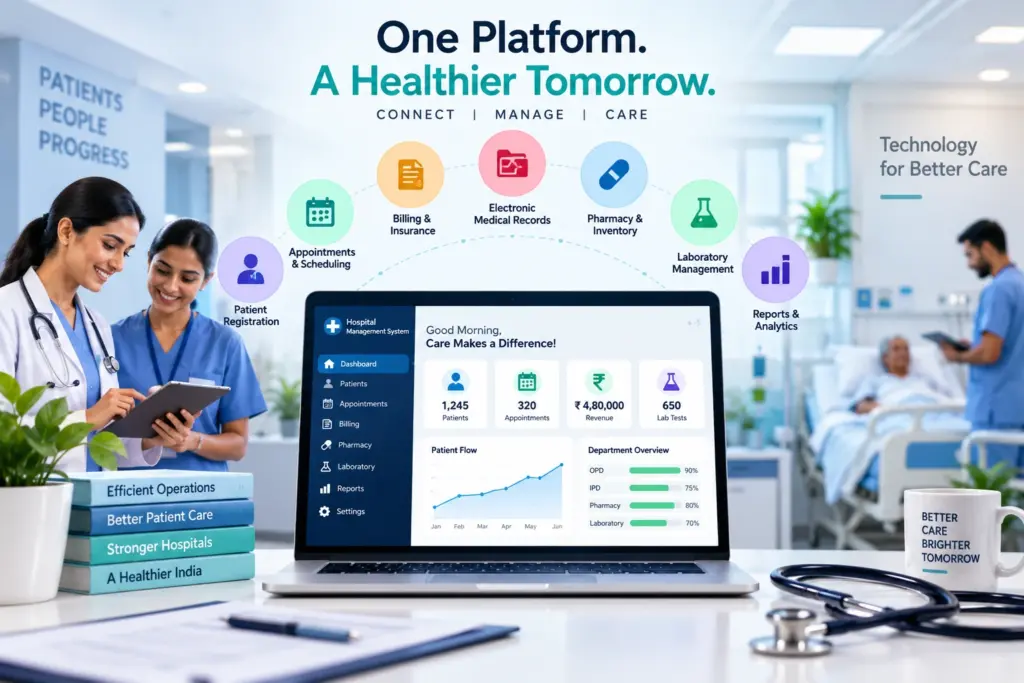
The best hospital management software should cover the full patient journey, from registration to billing, in one connected platform. These are the core modules to look for.
Patient Registration and Management
Quick registration with a single, unified profile per patient across every department.
Appointment and Scheduling
Organised doctor calendars, OPD queues, and automated reminders that reduce no-shows.
Billing and Insurance
Accurate, automated invoicing with GST-compliant billing and TPA or insurance claim handling.
Electronic Medical Records
Structured digital records capturing history, diagnoses, treatment, and quick discharge summaries for informed care.
Pharmacy and Inventory Management
Stock control with expiry and batch tracking, linked to prescriptions and billing.
Laboratory Management
Test orders and results that flow directly into the patient record, with analyzer integration.
Reports and Analytics
Real-time dashboards on revenue, occupancy, and performance for confident decisions.
What Should You Consider Before Choosing Hospital Management Software?
Before choosing, evaluate usability, scalability, integration, security, access, and the quality of vendor support, not just the feature list. A powerful system your staff can’t use is a poor investment.
Is the Software Easy to Use?
Staff should be productive within days, not months. A clean interface lowers training time and boosts adoption.
Is It Scalable for Your Hospital?
The system should grow from one facility to multiple branches without a costly replacement later.
Does It Integrate With Other Healthcare Systems?
Look for support for standards like HL7 and FHIR, plus ABDM and PACS integration for imaging, so records connect across systems.
Is the Data Secure?
Patient data is sensitive. Insist on role-based access, audit trails, and full compliance with India’s Digital Personal Data Protection (DPDP) Act.
Is Mobile or Cloud Access Available?
Cloud or mobile access lets doctors and administrators reach data securely from anywhere, while on-premise remains an option for facilities that prefer in-house control. Even an on-premise deployment can be configured to provide secure access from outside the facility when needed.
Is Vendor Support Reliable?
Check the vendor’s track record for responsive local support and structured training, since that determines how quickly issues get resolved after go-live.
How Does It Improve Patient Management?
The main benefit is a hospital that runs as one connected, efficient system rather than a set of disconnected silos. The table below summarises where the value shows up.
| Benefit | What it means for your hospital |
|---|---|
| Operational efficiency | Connected departments and less duplicated work |
| Patient experience | Shorter waits, smoother visits, better retention |
| Data management | One secure, complete record per patient |
| Billing accuracy | Automated, GST-ready invoicing with fewer leaks |
| Reporting & analytics | Real-time visibility for better decisions |
| Cost savings | Less waste and rework, tighter financial control |
How Much Does Hospital Management Software Cost in India?
Costs vary widely by deployment model, number of modules, users, and hospital size, so most vendors quote on request. As a general guide reported across the Indian market, subscription pricing commonly ranges from around ₹1,000 to ₹5,000 per month for small clinics, up to ₹25,000 per month or more for hospitals, with large enterprise setups running higher. When comparing quotes, always ask for a written breakdown covering the subscription, implementation, training, and support, since a low first-year price that leaves these out can cost more over time.
How Can You Choose the Right Hospital Management Software for Your Hospital?
Choose by matching the software to your hospital’s real workflows, then validating it with a hands-on demo. Follow these five steps.
Assess Your Hospital’s Requirements
List your departments, pain points, and must-have modules before you look at vendors.
Compare Features
Shortlist systems that cover your priorities such as OPD, IPD, billing, pharmacy, and lab, without paying for what you won’t use.
Check Configuration Options
Confirm the software can adapt to how your hospital actually works, not the other way around.
Evaluate Security and Support
Check data protection, uptime, and the quality and responsiveness of local support and training.
Request a Demo
See the system on your own workflow, involve the staff who’ll use it daily, and ask about implementation timelines.
Is Neeti Healthcare the Right Hospital Management Software for Your Hospital?
Neeti Healthcare Technologies is a Bengaluru-based healthcare IT company whose Eliven suite includes a Hospital Information System, plus dedicated LIMS, pharmacy, clinic, and diagnostic-centre solutions that work together as one connected platform. Made in India and built around local workflows, standards like NABH and NABL, and ABDM-ready interoperability, it can scale from a single facility to a multi-branch group. Deployment is flexible, cloud or on-premise, so you choose what fits your infrastructure and budget.
Frequently Asked Questions About Hospital Management Software
There is no single “best”. The right choice depends on your hospital’s size, departments, and budget. The best system for you is one that covers your core workflows, is easy for staff to use, integrates with ABDM and other systems, and offers reliable local support.
At minimum: patient registration, appointment scheduling, electronic medical records, billing and insurance, pharmacy and inventory, laboratory management with instrument interface, and reporting with analytics.
It varies by modules, users, and deployment. Subscription pricing commonly ranges from around ₹1,000 per month for small clinics to ₹25,000 per month or more for hospitals. Our own subscription includes the software, support, and upgrades, so always ask each vendor for a written, all-inclusive quote.
Yes. Many cloud-based and on-premises systems are designed to scale down affordably for small hospitals, clinics, and nursing homes, letting you start with core modules and add more as you grow.
Most modern platforms support integration through APIs and healthcare standards like HL7 and FHIR, and increasingly with ABDM, allowing records to connect across labs, pharmacies, and other systems.
Reputable systems protect data with role-based access, encryption, and audit trails, and align with India’s data-protection requirements. Always confirm the vendor’s security practices before committing.
Yes. Good software is configurable, letting you adjust modules, workflows, and reports around your hospital’s specific needs rather than forcing you to adapt to rigid software.
External resource: Learn more about India’s digital health framework from the official Ayushman Bharat Digital Mission (ABDM).
Simply contact us or message us on WhatsApp to book a free demo at a time that suits you.