

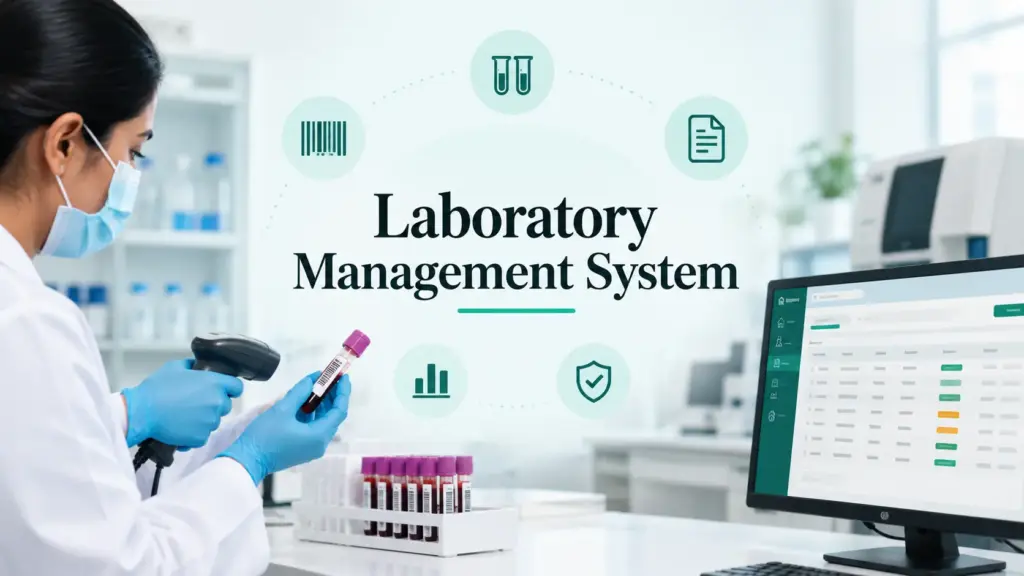
What Is a Laboratory Information Management System? Features, Benefits, and Uses
India’s diagnostic industry now spans well over a lakh laboratories nationwide, and industry estimates put the sector’s value at several billion dollars, growing at a fast pace year on year. Behind every one of those labs is the same daily challenge: keeping track of thousands of samples, tests, and results without losing accuracy or speed. A laboratory information management system is the software built to solve exactly that problem, replacing manual spreadsheets and paper logs with a connected, traceable platform for running a lab. NeetiHealthcare has seen this shift firsthand across diagnostic and hospital laboratories in India, where rising test volumes and stricter accreditation requirements have made digital lab management essential rather than optional. This guide explains what a laboratory information management system is, how it works, and where it’s used.
What Is a Laboratory Information Management System?
Quick answer: A laboratory information management system, or LIMS, is software that helps laboratories manage samples, data, and workflows from one connected platform. It replaces paper logs and disconnected spreadsheets with a digital system that tracks every sample from the moment it’s collected to the moment a report is delivered.
In practice, a LIMS centralises everything: patient and sample details, test orders, instrument results, and final reports, all in one place, so nothing gets lost between departments or handovers. For a lab processing hundreds or thousands of samples a day, that centralisation isn’t a convenience, it’s what keeps results accurate and on time.
How Does a Laboratory Information Management System Work?
Quick answer: A laboratory information management system works by following a sample through defined stages, capturing data automatically at each step rather than relying on a technician to write it down and re-enter it later.
Sample Collection and Registration
Each sample is logged and barcoded at intake, giving it a unique digital identity from the very first moment it enters the lab.
Sample Tracking
The lab always knows where a sample is and what stage it’s at, whether it’s waiting to be processed, currently being tested, or ready for review.
Testing and Result Management
Results are captured, often directly from lab analysers, cutting out the manual retyping that causes transcription mistakes.
Report Generation
A validated, shareable report is produced automatically once results are approved, rather than being typed up from scratch.
Data Storage
Records are kept securely accessible for future reference and audits, so nothing depends on a paper file surviving in a cupboard for years.
How the System Supports Each Stage
| Workflow Stage | How a LIMS Supports It |
|---|---|
| Sample collection and registration | Barcoding and digital intake reduce mislabelling |
| Sample tracking | Real-time status shows where every sample is |
| Testing and result management | Analyser interfacing reduces manual data entry |
| Report generation | Automated, validated reports ready faster |
| Data storage | Secure, centralised, and audit-ready records |
➡ See this workflow in action. Book a demo
Key Features of a Laboratory Information Management System
The core features of a laboratory information management system cover the full sample lifecycle, from intake to reporting. Each feature exists to close a specific gap that manual lab management tends to leave open.
Sample Management
Tracks each sample by barcode, from collection through testing to storage or disposal, so its full journey is always visible.
Patient and Test Data Management
Keeps patient details, ordered tests, and results linked in one accurate record, rather than scattered across separate logbooks and result sheets.
Automated Result Management
Captures results directly from lab analysers, reducing manual transcription and the errors that come with retyping numbers by hand.
Report Generation
Produces validated, professional reports, ready for delivery by print, email, or WhatsApp, without a technician needing to format each one individually.
Inventory Management
Tracks reagents and lab consumables so testing isn’t delayed by stockouts discovered only when a technician reaches for an empty shelf.
User Access and Data Security
Role-based access and audit trails protect sensitive patient and lab data, and support the kind of traceability that laboratory accreditation increasingly expects.
Reporting and Analytics
Dashboards on turnaround time, volumes, and lab performance give lab managers a clear, current view instead of a monthly guess.
Benefits of a Laboratory Information Management System
Did you know? Industry survey research on LIMS adoption has found that data management is the leading reason laboratories invest in a LIMS, with regulatory compliance and workflow automation close behind. Separate industry estimates on manual laboratory data entry suggest an error rate of around one in every hundred entries, which adds up quickly across a lab handling thousands of results.
The main benefit of a LIMS is a laboratory that runs faster, more accurately, and with a full audit trail.
Reduces Manual Data Entry
Automated data capture removes much of the retyping that causes transcription errors, particularly at busy times when a technician is handling several samples at once.
Improves Laboratory Efficiency
Connected workflows reduce the back-and-forth between departments and paperwork, so a result doesn’t sit waiting simply because a form needs to be walked from one desk to another.
Reduces Errors
Barcoding and analyser interfacing cut down the mislabelling and manual entry mistakes that are widely recognised as common causes of laboratory error, particularly in the collection and accessioning stages.
Improves Sample Tracking
Every sample has a digital trail, so nothing is lost or delayed without visibility, and a lab manager can answer “where is this sample right now” in seconds rather than making phone calls.
Supports Better Data Management
Centralised, structured data replaces scattered spreadsheets and paper logs, making it far easier to find a specific result from months ago when it’s needed again.
Saves Time and Resources
Less manual work means staff can handle more volume without added strain, which matters as sample counts keep growing across India’s diagnostic sector.
Function vs Benefit
| Feature / Function | Benefit |
|---|---|
| Barcoded sample tracking | Fewer mislabelling errors |
| Analyser interfacing | Faster, more accurate results |
| Automated reporting | Quicker report delivery |
| Centralised data storage | Easier audits and record retrieval |
| Role-based access | Stronger data security and compliance |
| Inventory tracking | Fewer testing delays from stockouts |
Talk to our lab specialists about your lab’s workflow.
Uses of a Laboratory Information Management System
A laboratory information management system is used across a wide range of laboratory settings, each with slightly different needs but the same underlying requirement for accuracy and traceability:
- Diagnostic laboratories, managing high daily test volumes across routine blood work, imaging-linked tests, and specialised panels.
- Hospital laboratories, connecting lab results directly to patient records so clinicians see results the moment they’re validated.
- Research laboratories, tracking complex sample sets with full traceability across long-running studies.
- Pathology laboratories, maintaining rigorous quality control on every result, where an error has real consequences for a patient’s diagnosis.
- Clinical testing facilities, running routine and specialised tests at scale, often across multiple collection points feeding into one central lab.
Laboratory Information Management System vs Manual Laboratory Management
| Area | Manual Process | With a LIMS |
|---|---|---|
| Data management | Scattered spreadsheets and paper logs | Centralised, structured records |
| Sample tracking | Manual registers, easy to lose track | Barcoded, real-time tracking |
| Reporting | Manual, inconsistent formatting | Automated, standardised reports |
| Accuracy | Prone to transcription errors | Reduced errors through automation |
| Efficiency | Slower, more rework | Faster turnaround, less duplication |
How to Choose the Right Laboratory Information Management System
Choose a LIMS by matching it to your lab’s actual workflow, then confirming it’s secure, scalable, and well supported.
Identify Your Laboratory Requirements
List your test volumes, sample types, and reporting needs before comparing vendors, since the right LIMS for a small pathology lab looks very different from one built for a large hospital laboratory network.
Check Essential Features
Prioritise sample tracking, analyser interfacing, reporting, and inventory management, the features that will be used every single day rather than occasionally.
Consider Integration
Confirm the LIMS can connect with your analysers, hospital systems, and billing software, so results, orders, and invoices stay in sync automatically.
Evaluate Security
Check for role-based access, audit trails, and support for accreditation requirements such as NABL, which expects traceability from sample to report along with documented internal quality control.
Check Scalability and Support
The system should grow with your lab’s volume, backed by responsive local support and training that doesn’t leave your team stuck when something needs troubleshooting.
Request a demo to see if it fits your lab.
Frequently Asked Questions
It’s software that manages a laboratory’s samples, data, and workflows, from collection and testing to reporting and storage, in one connected platform.
Core features include sample management, patient and test data management, automated result capture, report generation, inventory management, data security, and reporting and analytics.
Key benefits include less manual data entry, fewer errors, better sample tracking, improved efficiency, stronger data management, and time saved across the lab.
LIMS is used in diagnostic laboratories, hospital laboratories, research laboratories, pathology laboratories, and clinical testing facilities.
By automating data entry, tracking samples in real time, and connecting directly with analysers, a LIMS reduces the manual steps that slow labs down and cause rework.
Explore Laboratory Management Solutions with NeetiHealthcare
NeetiHealthcare is a Bengaluru-based healthcare IT company whose Eliven suite includes a dedicated Laboratory Information Management System, built for diagnostic labs, pathology labs, and hospital laboratories across India. It automates sample tracking, analyser interfacing, and reporting in one connected platform, and works alongside the Diagnostic Centre Management and Hospital Information System solutions for labs that are part of a larger facility.
Book a demo to see it on your own lab’s workflow.